Rechargeable gear is convenient, but storage and charging practices can affect your risk profile
0
The information on this website is general in nature and does not take into account your objectives, financial situation, or needs. Consider seeking personal advice from a licensed adviser before acting on any information.
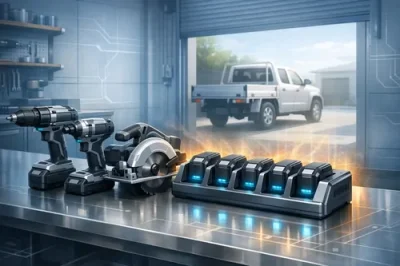
Recent industry attention on lithium-ion battery fires is a timely reminder for Australian tradies that rechargeable gear is now a core business risk, not just a convenience.
Cordless drills, grinders, saws, laser levels, test equipment, phones, tablets and battery packs are part of everyday work, but they also introduce fire, theft and interruption exposures that can be easy to overlook.
The issue is not that tradies should avoid battery-powered tools. For many trades, they are essential for productivity and mobility. The practical point is that batteries can fail if they are damaged, overheated, poorly charged, stored incorrectly or paired with unsuitable chargers. A fire that starts in a ute, van, garage, shed or workshop can quickly become much bigger than the cost of one tool.
For small trade businesses, the insurance angle is straightforward: the way tools and batteries are stored, transported and charged can affect both the likelihood of a claim and the evidence needed if something goes wrong. A damaged battery left charging overnight near flammable materials may create a very different claims conversation from a well-documented setup with compliant chargers, clear storage practices and regular checks.
This also links to sums insured. Many tradies add tools gradually over years, which means the replacement value of a kit can be far higher than expected. If batteries, chargers and specialist equipment are not included in your asset list, your cover may not reflect the real cost of getting back to work. It is worth taking time to estimate realistic replacement values before renewal, especially if your crew has grown or you have upgraded to higher-end cordless systems.
Good risk management does not need to be complicated. Useful steps include:
Using manufacturer-approved chargers and avoiding damaged leads or battery casings.
Charging batteries in a clear, ventilated area away from fuels, solvents, timber dust and packaging.
Avoiding overnight charging where there is no supervision or fire detection.
Keeping purchase records, serial numbers and photos of major tools and battery systems.
Checking whether tools are covered in vehicles, on site, in transit and at your workshop.
The bigger lesson is that tool insurance is not only about theft from a locked ute. Fire, accidental damage, storage conditions, exclusions and sub-limits can all matter. If your setup includes a workshop, employees, subcontractors or multiple vehicles, an insurance broker can help review how public liability, tools, contents and vehicle cover work together.
Battery-powered tools are here to stay. Treating them as part of your wider business risk plan can help protect your equipment, your cash flow and your ability to keep jobs moving after an unexpected incident.
Please Note: We do not endorse any specific products or companies. Some content is sourced from third parties, including press releases, and may not be independently verified for accuracy or completeness.
Recent transport industry coverage has again highlighted regulator attention on heavy vehicle roadworthiness, with roadside checks, defect management and maintenance systems remaining central safety themes for Australian operators. For trucking businesses, the message is not limited to avoiding fines or delays. Roadworthiness can also influence how insurers view risk, how smoothly a claim progresses and whether policy conditions have been met after an incident. - read more
Australia’s engineered stone ban and continuing regulator focus on silica exposure are more than a workplace safety issue for builders, renovators, tilers, stonemasons, plumbers, electricians and demolition contractors. They also create a practical insurance checkpoint for any trade business that cuts, drills, grinds, removes or works around dust-generating materials. - read more
Fresh motor insurance commentary across the Australian market is again pointing to a practical issue truck operators know well: repairing vehicles is becoming more complex, more expensive and, in some cases, slower. For heavy vehicle businesses, this is not just a workshop problem. It can influence claim outcomes, renewal pricing, excess settings and the amount of time a truck is off the road after an incident. - read more
Recent complaints data from the Australian Financial Complaints Authority has again highlighted a pressure point that matters to rural Australia: insurance claims can become difficult when expectations, policy wording and evidence do not line up. While the figures cover the wider insurance market rather than farms alone, the themes are highly relevant for agricultural businesses dealing with storm damage, fire losses, machinery failures, fencing repairs or interrupted operations. - read more
Fresh industry attention on ASIC's expectations for compensation arrangements is a timely reminder that professional indemnity insurance should not be treated as a once-a-year renewal task. For Australian professionals who provide advice, compliance support, financial services, consulting, design, technology or outsourced business services, the adequacy of cover depends on how closely the policy matches the work actually being performed. - read more
Australian cafe owners may face legal, contractual and commercial insurance expectations. This guide explains how workers compensation, public liability, vehicle cover, leases and optional business policies can fit together. - read more
Running a cafe can be a dream come true, but it's not without its challenges. One of the most critical aspects of managing a cafe is ensuring that it's adequately insured. Cafe owners in Australia face various risks, from equipment breakdowns to customer accidents. Without proper insurance coverage, these incidents can translate into significant financial losses. Insurance acts as a safety net, offering protection against unforeseen events and ensuring the business can recover swiftly. - read more
Customer claims in a cafe can arise from many situations, from a slip on a wet floor to illness allegedly caused by food or drink. This article explains how public liability and product liability differ, where they may overlap, and what Australian cafe owners should check when reviewing their insurance. - read more
Cafe contents, stock and equipment insurance can help protect the physical assets a cafe relies on, from coffee machines and fridges to furniture, inventory and some fit-out items. This guide explains what Australian cafe owners should consider when assessing cover, sums insured, spoilage risks and common policy limitations. - read more
Cafe owners often use cars, vans or utes for deliveries, catering, supplier pickups and other business tasks. This guide explains when business vehicle insurance may be relevant, what to disclose to insurers and how vehicle cover can fit into a broader cafe insurance plan. - read more
Knowledgebase
Replacement Cost: The amount it would cost to replace or rebuild an insured asset with one of similar kind and quality, without depreciation.




No comments yet. Be the first to share your thoughts.